Friday, October 31, 2008
9/11 is boring

Thursday, October 30, 2008
Law and Order: Network Intent
I started watching at 3:21 PM
Show....
Lorraine Dillon turns herself in for the murder of Patrick Sullivan
Commercials:
Season Finale of “Raising the Bar”, another show on TNT-- very much like L&O
ad for another TV show- fantasy
Glade Fabric and Air-- family
Kirsten the Talking Cow “auditioning” for a “Real California Milk” commercial
Lysol Neutraair-- very much like the commercial two before
Direct TV-- content of commercial totally irrelevant to what is being advertised
Network Television Premire: Da Vinci Code-- playing on TNT
Coming Up Next on TNT: Charmed “TNT: We Know Drama”
Law and Order:
Characters try to prove if Lorraine was telling the truth
Interview Sullivan’s ex-lover, Ms. Dillon, in a court room (?)-- Sullivan raped her daughter April at the age of 14 and that is why she didn’t marry him. She was being attacked by him and he had a gun. “The next thing I knew Patrick was dead and I was holding his gun.”
Mr. McCoy: exposes fraud... subtle suspenseful music... evoking emotion from the spectator and Ms. Dillon
Cut to courthouse steps and McCoy and a female lawyer talk about exposing potential lies in the April story
Cut to April being interrogated on the stand by McCoy and the female lawyer. It comes out that April and Patrick were consensual lovers. Lorraine killed Patrick out of jealousy and forced her daughter to lie for her.
So one of the women is lying.
Lorraine tells a story about how she was actually protecting April with her story and April is really the murderer
Cut to Jury’s ruling: Lorraine is guilty
Commercials:
Season Premiere of “Leverage” on TNT
Florida Orange Juice-- vitamins and minerals! “pure and simple”
Vonage “get more” “first month is free”
Raisin Bran Crunch-- sports guys
IHOP-- Strudel Pancakes...
Toaster Strudel
associatedtaxrelief.com --- “real stories, real results” in green in corner of screen
“Raising the Bar” Season Finale
Law and Order:
Conned
April was sent away because she was pregnant
Facility cook drove her to the hospital, but never reached hospital. Birth in the car
They were having sex
April buried the baby-- there was something wrong with it [suspenseful music]
Commercial
“You’re watching Law and Order” sponsored by IHOP
IHOP-- same commercial as before
Binder and Binder
Netflix--Snowing Popcorn
AARP Health Care Options-- choices! free...free... easy! endorsement by AARP!
NBA on TNT
Law and Order...
3:55
Comments:
First off, my favorite little tidbit of flow was going from the IHOP commercial for strudel pancakes to a commercial for Toaster Strudel. Brilliant! (though probably just a coincidence). I was also amazed by the flow from the first segment of Law and Order I watched to the first commercial: a crime/lawyer show to another one of the same type. It took me a few moments to register that there was indeed a seam between the show and the commercial. I also never noticed before that the segments of show get shorter and shorter and the commercial breaks become more frequent, until I read it in this week’s readings (despite thinking time and time again that there are too many commercials...). I did notice it this time!
Within the show itself, what was interesting was that even though I started watching one-third through the show, I was still invested in the plot by the end and stuck it out until the end to see how the story played out. And even though I was typing away, keeping track of the plot, the soundtrack at certain times, whether it be the suspenseful music or the distress in the characters’ voices, did indeed draw me in to actually paying attention to the scene.
Commercials and the Super Bowl
Reality
Advertisements
TV(s)
CNN
I Travel Guides
Announcer: Now is the perfect time for Americans to travel.
Juxtaposed “window-frames" of announcer and travel expert. Announcer: What might be the reasons for this phenomenon?
Travel Expert: The dollar is stronger than other currencies (the Euro, the Pound, the Australian Dollar, …)
(currencies compare-contrast chart)
Juxtaposed “window-frames" of announcer and travel expert. Announcer: Means of transportation. What is the situation with air-travel?
Travel Expert: Airlines are quietly discounting.
(film: airport, planes,…)
Juxtaposed “window-frames" of announcer and travel expert. Announcer: Other means of transportation?
Travel Expert: Deep discount on cruising.
(chart of prices)
Juxtaposed “window-frames" of announcer and travel expert. Announcer: Hotel prices?
Travel Expert: Low-cost lodging. Hotels give deals
(slide)
Juxtaposed “window-frames" of announcer and travel expert. Announcer: Are Americans taking advantage of these opportunities?
Travel Expert: No. People still uncertain about how they should use their discretionary income. Current financial crisis – also a factor
II Still image: name of travel expert and cnn website. Voice briefly presents travel expert.
III The cnn 2008 Hero Honoree
Announcer: Meet one of the candidates for the cnn 2008 Hero Honoree
Film: brief presentation of candidates.
Shift to another studio (2): Announcer: Meet one of “our Heroes”: Maria Ruiz from
Pattern – repeated several times with slight variations: Juxtaposed “window-frames" of announcer and Maria. Announcer welcomes Maria; asks questions about her project, her motivations
Maria: answers
Film of Maria at work OR still images – photographs of Maria and the children her organization helps OR page from JEM Ministries website
Announcer: comments on Maria’s answer and/or asks new question
Back to studio (2)
Das Erste ARD, 29 October 2008, From 7:37pm (US Eastern Time)
Weather Forecast for
Announcer: The weather in
Shift to the Weatherwoman. Weatherwoman: Very chilly tonight. Snow in the mountains.
Film: people skiing in the mountains
Rain/storm/sun map for Thursday. Weatherwoman comments.
Temperature (degrees Celsius) map for Thursday. Weatherwoman comments.
Three juxtaposed temperature (degrees Celsius) maps for Friday, Saturday, and Sunday. Weatherwoman comments.
Back to studio. Announcer: “Have a good night!” and the time of the next program on ARD.
Still image: “Kurze Unterbrechung” (short interruption) against blue background.
BBC World News, watched over the Internet at on http://news.bbc.co.uk/1/hi/world/default.stm (One-Minute World News) on 29 October 2008, From 7:44pm (US Eastern Time)
Image of a rolling globe. Program ID against image of the globe moving: BBC News
Announcer: (without (!) introduction) The latest headlines from BBC World News.
Voice of announcer: Police in
Fade out
Voice of announcer: UN Secretary Ban Ki Moon calls for drastic measures to protect developing countries against the financial crisis. (simultaneously) Film: Ban Ki Moon in session at the UN (?)
Fade out
Voice of announcer: The mother and the brother of the actress Jennifer Hudson have been found shot dead in their home in
Announcer: These were the latest headlines from BBC World News.
Comment(s):
- it appears to me that European TV news programmes (still) have a different “rhythm” (flow?) from the
Flow/Fracture
But what interests me about the instantaneous image does not lie in any sort of wholeness or purity; it is rather that, like the continuity of television, the single image (for the purposes of this argument, the image referred to here (the complete image projected by a television screen, whose boundaries are the edges of the box) will be from here on out referred to as "screen") is fractured into multiple. Each screen contains multiple images, multiple frames and boundaries that take up separate sections of the screen and are meant to convey separate sets of information. Yet, unlike flow, the fact that all these images are being throw at us at a single moment in time means that we cannot attempt to separate the groups of information and process them separately; we must either read a connection between each individual fracture or process them separately of one another.
The coverage of 9/11 provides a very simple example, yet one that is incredibly important to understanding television: the display of a station logo, a sort of "watermark," while "live" footage of "breaking news" plays behind. This "watermark" is the most common fracture; almost any program watched on a network or cable station will be broken by the station logo displayed transparently in one of the corners of the screen. It prevents you from ignoring the economic foundation of the television industry; no matter what you watch, you're always choosing one particular network, one brand over the others. The "watermark" serves both as a way to impose the myth of network branding upon the viewers, and also "mark" recorded video, clearly identifying bootleg copies and holding them captive within the framework of television; there is no way to access the "pure" program (without, of course, buying a copy of the work from the same company, which, by forcing you to repurchase media, forces you to give in to the myth of the network brand in the extend of the capitalistic system such that the watermark is no longer necessary).
There is one other fracture present at the beginning of the 9/11 footage: that of the headline: "BREAKING NEWS: WORLD TRADE CENTERS COLLAPSE". This element refers directly to the "live" image being displayed on screen, and both provides an interpretation and understanding for those already watching as well as immediately informing those just tuning in the nature of the situation being covered. While both these roles/acts seem different, there is one key similarity: the giving of interpretative powers from the audience to the network. While this first headline portrays something very factually, the headline eventually transforms into "AMERICA UNDER ATTACK", with the lines boxing off the fracture transforming into an American flag waving in the wind. In this case, the headline has been transformed by the network's ideology; it has been mythologized; it alters and transforms the viewer's interpretation of the "live." While this mythologizing does not fully stem from the network (in this case, the revelation of the terrorist nature of the attacks had become apparent, and the government had released briefs and reports detailing the attacks as mythologizing them as such), the power of the fracture to alter the interpretation of the live is something that is clearly dangerous. While I do not mean to insinuate that the 9/11 attacks were not, in fact, an "attack on America" (I'm not a 'truther' and do not take 'truthers' incredibly seriously), I am very against the Patriot Act, which was passed in the aftermath of 9/11 and was very much helped by some of the mythologizing that occured on the day itself, and am also against the Iraq War, which the Bush administration was able to force authorization of partially through the creation of a myth surrounding Iraq with the manipulation of fracturing and flow. The destruction/restruction of said methods is nowhere near as clear cut as the alternative cinemas of multiple writers, due to the determinance of the capitalist system in the creation and commodification of televisual networks; while some cable channels are able to offer alternative representations and interpretations of the news (see Current), they have nowhere near the same reach as mainstream networks. Also, even networks like Current, as well as "Internet television," seem to depend upon use of fracturing and flow to convey information, holding the same possibilities as mainstream television news.
Thursday, October 23, 2008
The liberation of the plastic arts
Life, Representation, and Truth
1. Barthes talks about life and death and the subject’s relationship to these two states as bestowed upon him by the photograph. He seems to say that the photograph bestows life upon the subject, makes him immortal, but also emphasizes the fact that he is going to die or is already dead. I am having trouble reconciling both points into one coherent view.
2. “Ultimately a photograph looks like anyone except the person it represents” (102). This is confusing because it follows a list of features which Barthes says are characteristic of the people
The concept of truth in photography that Barthes discusses all throughout CL is really interesting, and I agree with it. Everything that is shown in a photograph actually happened. I kept trying to think of instances that would disprove this very basic tenet of Barthes’s philosophy but I could not. Professor Chun brought up the concept of the fulgurator n lecture, but even so, the instance with the cross on Obama’s podium actually happened and there is no denying it, even if the cross was not material. And once we photoshop an image, it is no longer a photograph, but an instance of art, like a painting. It is something beyond capturing the essence of a subject, alters what has been, and therefore steps over the boundary of being photography.
Cinema and Death
Another interesting thing I noticed about myself during the film was how much I wanted to hear the recording of his death. Awful as this must sound, I don't believe I was the only one. The difference between a film and picture is that a film can show us the end result and a picture usually doesn't. In the case of this film however, its almost like the plot drives toward the climax of his death and when they reach the part where the film is suppose to produce the most effect, they skip over it and climb back down. I think some film makers do this to make the audience make up there own idea of something that would scare the crap out of them. For example, lets say in a scary movie there is a noise behind a closed door, maybe its a monster sound, who knows. Anyway you slowly creep toward and slowly open it. Now as the spectator what are you expecting? A monster? A murderer? A ghost? In my opinion 9/10 times what the spectator sees is usually not the scariest thing for them to see. THats why I like how some directors keep the door closed and make the spectator come up with their own demon.
Outtakes
Herzog makes a point of showing Treadwell's tendency to try several takes of a monologue, often showing the out-takes. While he praises Treadwell's ability as a filmmaker, how does this inclusion function? While Treadwell certainly made himself vulnerable before the camera and was a willing subject of the camera's gaze, is this the equivalent of Keenan's example of being shot while supposedly safely looking out of a window? Are these outtakes private? The exposure of these takes seems contrary to Treadwell's intentions as a filmmaker and as a subject, and Herzog's use of these shots even lead some critics to believe that Herzog wants the audience to see Treadwell as crazy or a buffoon.
It seems to me that this is also an obvious link to La Jetee, although the intrusion into private space is used more malevolently there. This is also not to accuse Herzog; I felt much more sympathetic to Treadwell after seeing the film than I would have thought before seeing it. And seeing Herzog's respect for the audio tape of Treadwell and Amie's death suggests an acknowledgement of a private sphere, or if not that, then a desire to avoid a fetishism or use of that real and horrible moment of violence for his own ends. I just wonder how Herzog or we (as individuals, or in society, whatever we want to go for) conceive of those who have died as objects, and how we think that respect for an individual's subjectivity or vulnerability change when that person is no longer alive.
Funny Bear
While humor obviously plays a very obvious role when we encounter Treadwell’s juxtaposition in his monologues (coming across at best bi-polar, and at worst crazy) I was frustrated by how rehearsed the other characters’ pieces were. The pilot’s story of his discovery of the bears seems overly dramatic: “Each time I flew over the bears started eating faster and faster” he tells, referring to the bears eating Treadwell and his girlfriend’s body. I found that while these pieces were effective for their shock value and while I’m sure Treadwell would have been happy at how polished the final product appeared, I feel that a certain amount of authenticity was lost in the process.
Another Quixotic (?) Search/Desire for the “Absolute”… - Notes
I
I would like to start by asserting that I find the theory that Barthes put forth in Camera Lucida to be extremely compelling, for several reasons.
1.1. Of all the thinkers studied so far on the course, (the late) Barthes seems to be the only one operating with an interesting version of the correspondence theory of truth, as opposed to the coherence one implicit in most of the texts discussed so far – particularly in Saussure. Thus, it appears that, in Barthes, the truth of a photograph (NOT of a proposition, as the traditional correspondence theory requires) presupposes the capturing of the “air” – of the truth of the subject (p. 109), the correspondence between the punctum and the real, between the subject and its image. On account of this, a photograph is almost invariably true “at the level of time” (“a just image”; p.70) – except for those cases in which the spectator is unable to identify the punctum or “the photographer cannot, either by lack of talent or bad luck, supply the transparent soul its bright shadow” (p. 110). Barthes’ implicit theory of truth belongs, therefore, to the realm of (in my view, unfairly discredited in the contemporary world) metaphysics.
1.2. Interestingly, in Camera Lucida, Barthes appears to postulate the “beyond”, attesting for a desire for the “Absolute” (the soul?; the Being?; “Pure” Existence as envisaged by Plato?). Could this “Absolute” be the inaccessible essence of (individual) life – the great un-representable – of which only the “Photograph” can offer a taste?
1.3. The photograph becomes, for Barthes, the (perhaps singular) reliable certification of existence (but does this imply that if something has not been photographed it “has not been” at all?) as well as, perhaps more importantly, a reminder of Death – the (most) fundamental human experience that appears to me to be largely ignored in the contemporary world through all sorts of distraction mechanisms (such as the cinema). Of all media, the "Photograph" is, I agree with Barthes, the one which raises the most powerful awareness about Death and its imminence, and it does so due to three of its defining characteristics: its time-disruptive effect; its “intense immobility” (p. 49); and its silence.
These characteristics are the ones which distinguish the photograph from film. On account of these, I believe – in opposition to Bazin and in line with Barthes – that cinema cannot give punctum, nor does it presuppose a “beyond” or make its spectators aware of Death. In a sense, cinema is the “profane” alternative to photography.
II
One of the most intriguing points Prof. Chun made in the lecture on Wednesday was for me the claim that ethics is a question of the relationship between the self and other and NOT of knowing. Even though my position towards this assertion is ambivalent at the moment (it probably lies somewhere in a “middle” ground), I am deeply surprised by the bitter contemporary “campaign” against knowledge … in an age which is often hailed as “the Age of (largely media-generated) Information”. Despite my reservations about the Socratic tenet that to know the “good” is to be good (at the cornerstone of his ethical theory) and later developed and reconfigured during the Enlightenment, I would argue for the necessity of recognising knowledge as absolute and of “knowing” as an essential component of ethics in order to prevent all discourses (about the self, subjectivity, and others) from “ending up” in the realm of the political and/or the cultural.
III
The screenings for this week: I was particularly fascinated with the idea/presence of the narrator in both La jetee and
IV
Does the Barthesian metaphysical theory formulated in Camera Lucida fit in the web of political and cultural theories dominant in the contemporary world? Is the “Absolute” an out-dated concept?
Photography and Psychoanalysis
Not quite a nature documentary
I thought that a punctum of sorts was present throughout the movie. After knowing that the main character will eventually die, all of his foibles and ramblings took on a grotesque aspect. Normally, I would have found his demeanor just annoying, especially his delusions of grandeur, but in the context of the film these actions seemed more pungent.
Most interesting (and distressing) was the tape of his own death. What first struck me is that he would, while facing his own mortality in the face of a hungry bear, have the presence of mind to turn on the camera to film his own death. The tape itself seems to represent the height of guilty voyeurism. I so wanted to listen to the tape, yet at the same time did not want anything to do with it. The filmmaker heightened this anticipatory desire by showing himself listening to the tape on camera. I cannot think of many more types of media that are as emotionally powerful as that tape, created by a man in his death- with the lack of video footage creating even more desire and fear in its consumers.
Wednesday, October 22, 2008
Editing and Photo Creation/Manipulation

Digital photography, Adobe Photoshop, and the RAW file format open up many new possibilities for photographers. Digital photographs only exist as data, 0s and 1s, and can therefore be spread and reproduced by anyone who owns a computer. Photoshop allows you to alter (or "photoshop") these digital photographs, allowing for the creation of images that either appear to be real despite their extrodiary (almost magical) nature, or are clearly "removed" from reality, existing in manner similar to that of the surrealists. RAW files allow photographers to edit the very settings of the camera used to take the photo, allowing for the adjustment of exposure, white balance, and color after the actual photo. While artists are busy exploring the possibilites of these techniques/tools, others find themselves scrambling to understand the implications of these techniques on the traditional notion that photographs represent reality (or, as Bazin states, that the artist in photography is nature, not humans) and trying to defend themselves against the issues digital techniques create.
Journalism, in particular, has been struggling to understand how to react to photography in 0s and 1s, particularly because it threatens the conception of "truth" that journalism strives to represent. The National Press Photographer Association has lain out a code of ethics, stating that photographers "do not manipulate images [...] that can mislead viewers or misrepresent subjects." This seeks to defend against the manipulation of the "real" that tools such as the image fulgurator use and draw attention to, in the fear that altering an image will cause those who view it to believe in an alternate version of history. Altering a photo can also add new implications to it; on the Time cover highlighting O.J. Simpson, removing the color saturation and "burning" the edges in what may have seemed to Time to be a way to add suspense, but ended up sparking a controversy over racism. The racist undertones that many saw in the image could have greatly changed perceptions of the events by mythologizing it. However, this power was diffused by Newsweek, who featured the unaltered photo on their cover. While the ability to recognize this type of photo manipulation was only given through subtractive abilities (this one is the original, therefore this one is not), photoshopping leaves behind noticable traces; pixels can be left out of place, or two locations in a photo may appear exactly the same. These aspects seem to diffuse whatever danger photoshopping may posses; they turned Iran's photos of missles into a popular meme, as these signs revealed the falseness of the photograph:

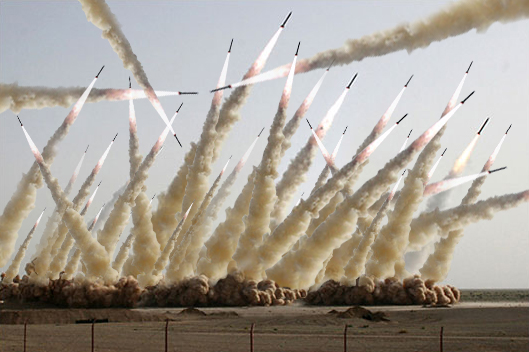
This means that the potential danger of photoshopping is undermined and perhaps negated by the mark it leaves and bestows upon the "original" photograph.
But again, not all editing is like this. In the case of the O.J. Simpson photograph, various elements in the actual chemical process (the process of creation) were altered to adjust the color of the image. RAW format digital photography makes this even easier, and even allows for greater control. However, if photography is not a "human" art, if the artist of photography is (as Bazin puts it) nature itself, how is it possible that, through use of various photographic techniques (in both the production and post-production phrases), one can manipulate a photograph and completely transform it so easily?
The danger becomes even more palpable with the discovery of photographs that have been vastly altered without use of digital techniques, that in fact pre-date computers? After purging various cabinet members and government officials, Stalin had them removed from photographs, hoping to erase them from "reality":


While he obviously couldn't erase them all from the "real" (due to both his actual existance and the inability of Stalin to destroy originals), one cannot deny that he was successful, to a certain degree; by displaying photographs in which the offender was suddenly absent, Stalin was able to make the public question his existance (as well as their memory).
There is a reason for this, one that both Barthes and Bazin tend to not discuss: photography is a human invention, a human tool. Bazin even goes as far as to separate the human from the photo, something that is impossible due to the inherent nature of "tools." Human agency is responsible for the creation of the photograph, and while the elements of the photo may be formed by nature, it is the photographer who frames the shot, adjusts exposure, and develops the photo. As these three examples show, this means that the "reality" that finds its way into the photograph can easily be manipulated by humans. It is the photographer who decides what to photograph, how to photograph it, how to develope and structure the physical copy, and ultimately which images should be preserved and should represent reality in the minds of the future.
Thursday, October 16, 2008
Class Accidents and Car Struggles.
This scene also plays into the bigger motif of car accidents. We see it right from the beginning when the thought of both Corinne’s parents and husband dying in traffic accidents comes up within the span of a minute. And then we hear Roland talking about he wants Corinne to die in the same way. And of course when the couple kills Corinne’s mother, they must burn her body... in a car. The car is a symbol of capitalism. It is expensive and something that the world can see and judge you by. So, how better to assert your right to a free market than to totally disobey traffic laws and common courtesy like Corinne and Roland do in the scene on the long stretch of road. And probably all of the audience has a car. One cannot help but think about their car being damaged in an accident, whether it is the small tap that occurs in the beginning of the film or the huge fire than destroys Corinne’s Hermes handbag (which is clearly more upsetting than all of the people who were destroyed in all of the prior accidents they just drive by). All of the accidents feed into the displeasure for the viewer. The accidents, the mangling of cars, are metaphorically the destruction of consumer society which is the goal of counter-cinema.
Pleasure vs. Unpleasure
Pleasure and Violence
Appealing to Everyone
Technology and Evolution of Cinema
While I think that this viewpoint is certainly interesting, and perhaps correct in some ways I am not convinced that it completely represents the current state of mainstream filmmaking. Certainly many films do fit into similar basic narratives, but this seems bound to happen as similarites are impossible to avoid. And I will admit that many films do rely on a set audience, appealing to them with explosions and movie stars. But even with these films being created, what about the mainstream movies that do represent innovation? It seems to me that Corrigan didn't mention the benifits that technology has on constructing new experiences and ways of seeing things. New stylistic devices and effects do create a new way of seeing things, and there are innovative plot lines even in the blockbuster class. Cookie cutter movies may be the norm, but I dont think cinema has been negativly affected by heightened technology.
Weekend: I giggled, but so what?
Second Cinema is Cool
Parody/Autonomy
After watching Godard’s film Weekend, my first impulse was to identify it as “pure” parody (the integration of various historic figures such as Saint-Just, or of fictional characters into the film as well as the self-referential dimension of the film clearly indicate the parodic aspect). The implication in this line of thinking was that, as parody, the film cannot have autonomy, and, as a result, it cannot represent the hailed (autonomous!) alternative cinema (“counter-cinema”) that Wollen writes about. At a more careful consideration of the film and after reading the essays for this week, I realized, however, that there is more to Godard’s film than just parody. The deliberate inversion of the key aspects of "orthodox" cinema (identified by Wollen and discussed in the lecture) account for an – I am tempted to say somewhat surreal as well as original, though I am aware of the paradox of asserting the originality of parody – arrangement of the “material” in the film that gives it autonomy. In my view, Godard found a (very simple) recipe for a new type of cinema that works on the principle of “denunciation” and that, most importantly, is autonomous despite the fact that it “feeds on” other cultural products. The essence of Godard’s success lies, I believe, in the consistent denunciation of (and departure from) all the principles of "orthodox" cinema, with the result of obtaining something "new" that, in a sense, incorporates the “old” by representing its reversal.
Political statement/Intellectual game
But is this “new” completely – or even reasonably – comprehensible? In my view, in Weekend there are bits of “information” (I am not sure how compatible this term is with a Godardian film) deliberately missing (such as the circumstances of the kidnapping of the protagonists, for example) as well as elements that appear to be redundant (in fact, a great deal of the film may appear thus, if the Godardian system of symbols is not fully grasped). These deny access to the meanings of the film for all except a few “privileged” spectators. The question that then arises is: is Weekend (and Godard’s counter-cinema) a political statement or merely an intellectual game? Because of the references to the “class struggle” – which, I believe, is being parodied; to a state of affairs that is up-side-down and in dysfunction suggested by the symbol/metaphor of the cars involved in accidents; and because of the obvious (postmodern) fragmentation in the film (at all levels, particularly at that of the narrative), I think it is undeniable that Godard’s counter-cinema has a political dimension. On the other hand, because of the randomness it involves and the principle of “reversal” it is based upon, it is also undeniable that the film is an intellectual game. Therefore, I would conclude that Weekend (and Godardian counter-cinema) is an intellectual game that counts as a political statement. How is that possible? Isn’t that a contradiction? I think not: the two are perfectly compatible provided that the political statement is postmodern (relativist and centered on representation), as I find it to be - even though I am aware that Godard identified himself as Marxist-Leninist.
Wednesday, October 15, 2008
The Definition of Quotation/ Politics?
I liked Weekend. But something about me likes Buñuel better... but we haven't screened Buñuel, so I'll stay away from comparisons.
I like Godard because he poses a lot of excellent questions. The first thing that strikes my mind is the use of "quotations." Wollen defines/Godard uses quotations in a very theatrical way; the actors merely read the words of someone else, whether they are reciting a famous speech or reading the lines of a script, written by someone different than themselves. However, to me this cannot be "true quotation"; the actors may not have control over the words they say, but in varying pitch, tone, speed and other qualities (qualities not dictatated by the "quote"), they can distort the quotation into something very different (see John Cage's Empty Words (parte III)). Within Weekend, the quotation is made obvious by characters acting in absurd ways that don't seem to connect to the period of the central characters of the film. This brings of the question of definition: how exactly do we define "quotation"?
Given Godard's love for displacement, it's suprising he didn't use another form of quotation, that is, direct quotation of film. This would entail creating a film constructed entirely of clips/quotes of other films reconstructed, reconfiguered, and remixed together. Things like this have already been done, but mostly in the music world, where it is easy to mix together recordings/samples/quotations to form a new whole. From that end, it seems as if the results can vary widely, from the deconstruction of pop culture from a quantifyable mass to a series of texts and objects that can be reapropriated, manipulated, and played with (a tactic that started with Steinski and has expanded to include the Dust Brothers and Girl Talk, and has also been used to more radical/absurdist ends by Negativland), or used to "rebirth" old recordings, constructing a new ideology by restructuring those that have been forgoten or ignored in the past (the whole crate digging movement; it's worth mentioning that recient "crate diggers" such as Madlib and Daedelus have begun manipulating their samples to radical/absurdist ends, making it nearly impossible to recognize the source, or even what instrument a sampled phrase is). There are other ways of manipulating sonic "quotations" as well, such as the DJ set, but while these certainly apply to film, the DJ set still (for the most part) depends heavily on the individual fragments (hence the importance of the set list; again, it's worth noting that people like Richie Hawtin have begun deconstructing this notion (see DE9: Transisitions)). While a lot of work has been done since Godard of this type, I do not know of a film that has been constructed entirely from other pieces of film and has influenced the film community. While "remixes" of both Gone With the Wind and Birth of a Nation are interesting first steps in this direction, there is still much that can be done here.
As a quick side note, I can't help but feel the music example in the last paragraph marks this post as separate from those posts that seem to go much deeper theoretically. So, I'll pose these questions: can you separate film and music today/where is the line between them? Does film rely upon audio aspects (including music: notice that even Godard made use of soundtracking, and that soundtracks used to be a location for intense experimentation (the soundtrack of The Twilight Zone, as cliché as it might sound, is a great example), or can music create any impact beyond emotional without use of imagery or some visual component/why is the live performance privaledged over isolated recordings? How has the creation of films (and the use of music within films) transformed music?
2. A Political Godard(Question Mark?)
There are two threads of commentary within the blog posts that seem strangely complementary to me. Ioana says that Godard is parodying the "class struggle," and others believe that Godard's revolutionary/second cinema was constrained in its political power, a fact that forced the makers of third cinema to seek a new form/a new aesthetic with which they could create revolution and fight against (neo)colonialism. What should we make of this opposition, and what (if anything) could this tell us about both the makers of third cinema, third cinema itself, and Second Cinema (was its intent to be revolutionary, if this is the case)?
Thursday, October 9, 2008
Masculine/Femine and Feminine/Masculine (re)Construction
In her response, Ioana asks:
Next, I'll start with a quote from Geoff:
I fully agree (I also apologize for the continued italics, Blogger seems to be broken at the moment). Deconstruction's goal is suppossedly to fully deconstruct/undermine/destroy a structure or metaphysical assumption. While you could argue that this would create a blank space, I'd argue that this argument is pointless; Derrida himself has admitted that "true" deconstruction is impossible, meaning that his work falls somewhat short and therefore must be different (despite the sameness). In fact, the creation of the term "deconstruction" to describe Derrida's work most likely holds him back; by attaching a signifier to his work, Derrida is limited and contained. In this case, the question becomes not "what is the result of ideal deconstruction" but "what is the result of all deconstructive work that has been done and can be done." In the creation of a "deconstruction," writers are forced to "construct" a "deconstructive text," which simultaneously deconstructs a structure/metaphysical assumption and re-builds/structures/constructs it into something different and (ideally) better. Take for example deconstructive architecture; by subverting the idea of "purely functional" architecture, deconstruction revealed the artistry inherent within the field and allowed it to bloom independently, allowing for works such as those of Frank Gehry (horrible example, I know, but it's the one everyone here is most familiar with), that can both convey meaning outside of its intended use and subvert the implied end results of urbanization and gentrification.
Deconstruction (as it is actually utilized) cannot exist without a (re)construction, and therefore must create a new subject in its attack on the old both to act as a instrument for agency to act through and to take the place of the old subject. What's interesting is that it is both new yet exists in the same space as the old (or perhaps displaces the space of the old to somewhere else; the location of the space is irreleveant here, as most (if not all) variables), both a deconstruction and a reconstruction. It is effective because it is able to frustrate dichotomies in both its creation and its methods.
Well, I need an ending, and this appears to be it. My response seemed to become less of a response to the reading and more towards the section, but if not here then in section. I look forward to hearing responses.
Violence to the Self
Responding to the Accusation of Nonbeing
"...the feminist denunciatory/deconstructing discourses of the past decades have by no means solved the problem, but converted the mentioned lack into incapacity. The “liberated” (non-)subjects cannot produce autonomous symbolic representation that Doane hopes for either. "
Ioana brings up a common argument brought against post-modernist thought-- that such persistent deconstruction produces a sort of discursive paralysis.
I think, that the feminist discourse of deconstruction has been anything but unproductive in its deconstruction of the "woman" and "man." (Note: I think that Ioana's assertion that feminism is fixated on the "in one go" decimation of "woman" with no attention to "man" [leaving him "intact"] does not hold up in light of the body of work present on the deconstruction of man in feminist literature. Also, on a theoretical level, even if a feminist work is in the end fixated on "woman" identity, the unravelling of "woman" inevitably comments upon and deconstructs "man"-- such is the specific relationship of our gender dualism.) The accusation of paralysis does not seem to hold up to empirics, which offer examples of female liberation as directly proceeding from feminist theory (sexual empowerment, marriage redefinition, reproductive rights, etc.).
I find no reason to consider feminism as a means of perpetuating female subjugation. Feminism's "disempowerment" of women by stripping them of their "woman" status seems absurd, as feminism does not leave women without new status/labeling/"subjectness." I would argue that the act of critique creates a new space which in itself offers a definition for women.
The work of Doane, in my view, provides an important deconstructive analysis of gender, which I find by no means to be self-defeating or perpetuating female disempowerment. As for its alleged paralyzing effect, I argue that to not discuss this dynamic would be a far more immobilizing position.
Cultural Constructs and Discourse(s). (Non)being
In the Monday lecture, Jeremy confidently gave two positive answers to the questions I asked: “Is Woman a cultural construct?”; “Is Man a cultural construct?”. Yes… I completely agree! In fact, I realized shortly after posing these questions that they are, in a way, tautological: the concept of “gender” has reconfigured the notions of “Woman”-“Man” (or, more specifically, female-male) to mean precisely cultural constructs that stand in a – rather ambiguous – relation of correspondence to “sex”. However, Jeremy’s answers made me acknowledge an already known (to me) fact as well as become aware of another issue: the vast majority of the texts we have dealt with in this course lately are concerned with denouncing/deconstructing “Woman” as a cultural construct. But what about “Man”? Why is the concept of “Man” as cultural construct not addressed or, at most, addressed only by implication?
In my view, the feminists’ (which is, I know, a very broad category) centering of their discourses on the denunciation/deconstruction of “Woman” as cultural construct created by men at the expense of that of “Man” as a cultural construct is not a very inspired choice. That is because an approach of this kind undermines women’s identity (however culturally constructed that might be) – and it does so at once (“in one go”). The result is disempowerment, for a “subject” without identity is, I believe, a non-subject incapable of engaging in action of any type (and, especially, political). Instead of a gradual deconstruction of the “Woman” cultural category accompanied by a simultaneous rebuilding of the category from a feminist perspective, feminist discourse(s) destroy the patriarchal “Woman” cultural construct, leaving the “Man” construct virtually intact.
In her essay The Desire to Desire, Mary Ann Doane discusses a lack of female autonomous symbolic representation – particularly regarding female spectatorship – as characteristic of the pre-deconstruction (feminist) age. In the light of the points made above, I would argue, however, that the feminist denunciatory/deconstructing discourses of the past decades have by no means solved the problem, but converted the mentioned lack into incapacity. The “liberated” (non-)subjects cannot produce the autonomous symbolic representation that Doane hopes for either.
My conclusion: feminist approaches might have “unintended” consequences detrimental to the very goals of the feminist discourse(s).
Clarification
"Several theories have noted that consumer culture and the culpable masses blamed for its existence have often been figured as feminine. Tania Modleski examines this aspect of historical accounts and emphasizes the problems involved in either simply condemning or celebrating these feminine inscriptions. Andreas Hyssen has also explored attacks on sentimental culture0slurs based on fears of the engulfing ooze of the masses which provoked the "reaction formation" of a virile and authorial modernism. Yet he concludes hisd analysis by claiming that such gendered rhetoric has diminished with the decline of modernisms. " mass culture and the masses as feminine threat-such notions belong to another age. Jean Bauldrillaurds recent ascriptions of femininity to the masses notwithstanding."
I was wondering if we could possibly make this section clearer for me because I read it many times and still don't understand it.
"Gold Teeth and the Curse of This Town"
Polarization
Gender in television?
While the arguement that the choice of a woman and a child as assitants was interesting to me, and perhaps could represent a leaning in a gender-oriented direction, the notion that a fat man watching tv and then exploding- represented the feminine nature of televison threw me off.
I would certainly agree that roles portrayed by women and men within the context of television shows do show a bias in terms of sexuality, i do no think that it is the medium of televison in itself that causes this or adds to it. I am not entirely familiar with programming pre-1990, because i wasnt watching tv at that point, i feel that many modern shows behave in the same way that cinema does. And the ones that dont, (game shows, reality shows, sit coms) do represent a voyeuristic intent, but still do not come across to me as inherently feminine. Hopefully someone can point out what I am missing about this analysis.
Friday, October 3, 2008
The Humanity of Kong
However, I feel as if this interpretation is a little too simple, and ignores some of the very valid points brought up by Snead. However, it contains some points Snead seemed to pass over quickly or ignore, such as the implications of the "humanness" of Kong. One of the main things that surprised me while watching the film were the differences between this version and Peter Jackson's (which I had seen beforehand). In Jackson's, Ann comes to sympathize with Kong, which gives the final moments of the film a very palpable sorrow at the death of Kong. She pleads with Denham to not capture Kong, to leave him be. In this case, Jackson has taken the themes seen by my friend and brought them into the open, avoiding the problems inherent in the original's ignorance of them. In the original, absolutely no one sympathizes with Kong; the natives live in fear of him and worship him as a god (in a way that carries tones of pageanism), Ann simply screams the entire time she is around Kong (which, as my friend pointed out, is a very reasonable response to being carried around by a giant gorrila, but, when placed in opposition with Jackson's film, is rather striking, especially in Ann's total lack of any sympathy (replaced instead by joy) when Kong dies), and Denham merely uses him as a blank signified, open to whatever signifier Denham desires to place upon him (most apparent is the signifier of "beast," but also race). While the audience can feel sympathy for Kong, they (within the context of the film) are completely alone in doing so. By throwing the audience into conflict with "society," the directors of Kong assure that whatever dangerous potential this sympathy has is quickly subverted and redirected towards Ann and Jack.
But, if we choose to see Kong as a figure constructed by racism (due to most, if not all of the reasons presented by Snead), this sympathy and implied humanity is even more dangerous and destructive. By making Kong appear nearly human, it is that much easier to associate him with the "Black man," a person who appears similar to the "White man" but has a major and dangerous difference/"impurity" revealed by skin color. In this light, Kong appears human, but is not fully human; we cannot see ourselves as his equals because, despite his innocence, is still a monster, and wrecks havoc when allowed to roam freely through the "civilized" world. The implications of this should be clear.
Also dangerous are the sexual images associated with Kong, specifically removing Ann's clothing and snatching her from her wedding bed. While there is a sense of innocence inherent in these actions (again, the argument that Kong is innocent and does not understand what he is doing is very applicable), this does not provide a reason as to why these specific images are used and repeated. As Jackson's film shows, there are many other ways to show Kong's innocence that do not involve implicit sexuality.
In this case, we can assume that the sexual implications of these sequences are intended. These images (as Snead notes) are somewhat reminicient of racist characterizations in films such as "The Birth of a Nation," where a girl falls off a cliff and to her death in an attempt to escape from a black man who desires to marry her by force. However, unlike "Birth of a Nation," the sexuality in "Kong" is not concerned with marraige; while the black man in "Birth of a Nation" never mentions sex, merely marraige (which implies sex, but also hides it and represses it), Kong is explicitly sexual. Also, we actually see from the point of view of Kong as he removes clothing from Ann. This is why I agree with Snead in his assertion that the figure of Kong provides a place for us to project our repressed fantasies and guilt. This is the second purpose Kong's humanness plays. These two seemingly opposing purposes do intersect; when Kong is shot off the Empire State Building, we are forced to recognize the otherness inherent in the monster and become even more resolute in repressing our fantasies and guilts, as unleashing them upon the world will have the same effect as unleashing other races. It cleanly strenghtens the connection between race and sexuality; that "dangerous" races also contain "uninhibited" and "monsterous" sexuality.
Thursday, October 2, 2008
Enlightenment?
I was particularly interested in the role of light in Rear Window. Jeffries uses light as a tool and weapon: without it he is powerless. Illumination is an intrinsic factor of film, especially in a voyeuristic genre. For example, the newlywed couple across the courtyard always has their blinds drawn with the light perturbing through. Yes, they’re having sex; but no, we can’t see it. This relates to Keenan’s Windows discourse on the separation of public and private. Moving on, light is also used as a weapon in the penultimate scene of the movie when Jeffries uses his flash to slow down his defenestration, caused by Lars Thorweld. The role of light is necessary and intrinsic to voyeurism, both in the conscious and subconscious perceptions of it.